7-Day Balkan road trip for fall: Albania, North Macedonia, & Kosovo itinerary
Following my last year’s trip to the Balkans, I wanted to explore the rest of the region. The diversity of the area, the food, and the people you meet on the way made my last trip really exciting and I was up for more. To explore the countries I had left last time, this time we visited Albania, North Macedonia, and Kosovo. Below you’ll find the route that we took for inspiration!
- Itinerary
- Day 1 – Arrival to Albania: drive to Apollonia & Berat
- Day 2 – A taste of Albania: Berat, Durrës and Krujë
- Day 3 – Ohrid, North Macedonia: Churches and Lake Views
- Day 4 – A drive through North Macedonia: Matka Canyon & Tetovo
- Day 5 – Visiting Popova Šapka and drive to Skopje, capital of North Macedonia
- Day 6 – Excursion to Peja, Kosovo
- Day 7 – Visit Pristina, capital of Kosovo, & head back home
- Practical information
- Looking for more inspiration?
Affiliate Links
This page contains affiliate links. If you click through and make a purchase, I may earn a small commission — at no extra cost to you. Thank you for supporting the site!
Itinerary
Day 1 – Arrival to Albania: drive to Apollonia & Berat
Apollonia
I arrived at the Tirana airport, where I rented a car and headed to Apollonia, a large archaeological side in the south of Tirana. It is located about 1,5 hours away of the capital, close by the city of Fier. Apollonia is a UNESCO Heritage Site, which can be visited for 600 ALL. It used to be one of the most important cities in the Adriatic basin, and it was founded in the 6th century BC by the Greeks. Inside the city limits, you can visit the ruins of several great building of the era, including a Theater, an Agora, or the Temenos.
The site also incorporates buildings constructed on later timepoints, such as the Church of St. Mary. This church was constructed using building blocks from the already then archeological site. There is also the Acropolis, where most of the original construction is gone, leaving only modern bunkers built during the war.


The site is relatively large, and you can easily spend there a couple of hours, especially if you’re following the suggested route. I did find the map of the place quite confusing, as often the signs pointing towards directions did not match the names used on the map. Since it was already getting late, I drove towards Fier, where I had lunch in the Restorant Niku. This restaurant had an excellent selection of fish, for which it has excellent recommendations in Google.
Berat
Because I visited in November, sunset already took place at 16:30, and I didn’t have time to reach Berat in time to see it. After parking and checking-in in my hotel, I arrived to the city center, only to see the night Berat. At night, the city is also beautiful. There were still some souvenir stores open, and while the streets had people on them, it did not feel crowded. I walked a bit around the city center, crossing the Suspension Bridge and the Gorica Bridge to explore both sides. The south part of the river is much more residential, while the north bank of the river is more lively.
I had dinner at the restaurant recommended by the hotel host, the Eni Traditional Food Berat, which had traditional dishes. I tried a dish called Fergese, a baked dish with peppers, garlic, tomatoes, and cheese.

Day 2 – A taste of Albania: Berat, Durrës and Krujë
Berat
Once the sun was out, I went uphill to explore the Berat Castle. When I arrived there was still almost no one, so I could walk around and take photos without people. The castle has several walls which protect some medieval streets. From the castle, I walked to a viewing platform, from which I could observe the city of Berat. From the platform, I walked towards the Akropolis, a region that includes part of the fortress, a water cisterne (that has some species of bat living there), an ancient mosque, and St. Trinity Church. When I approached the church it was still closed, but while I was there, a man approached the door and offered visiting it. Inside, I could see some frescoes, although they were quite fragmented.

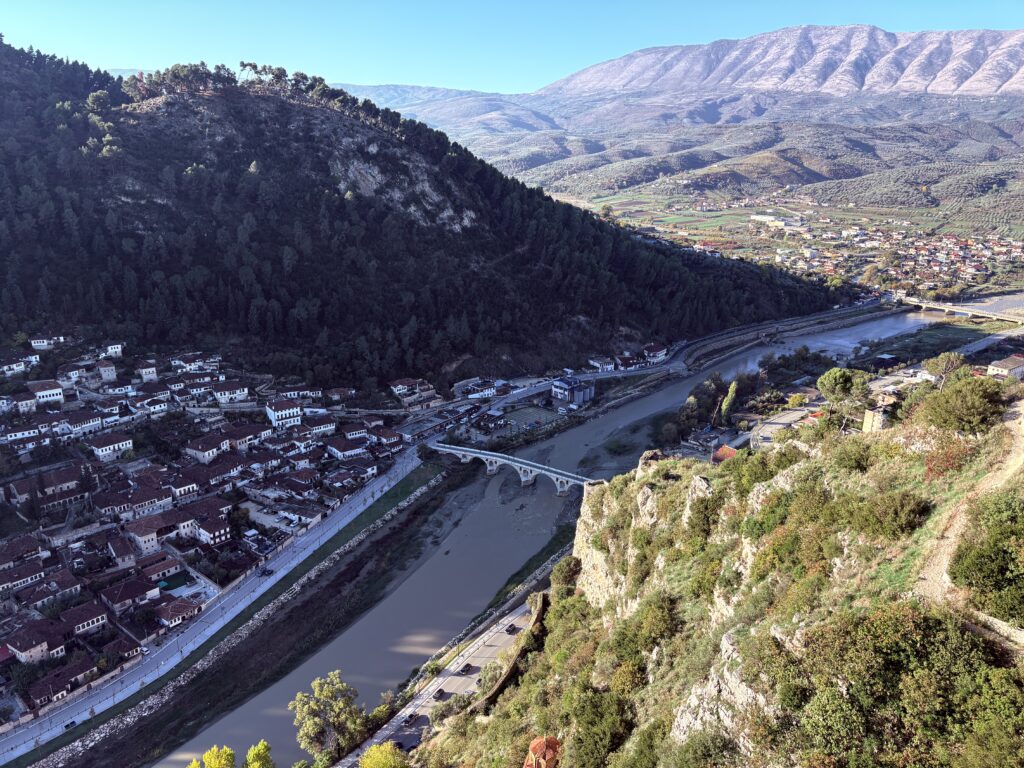

Back to city, I walked a bit on Berat streets to see them under daylight, and then dropped into a café to have some breakfast. I then returned to my hotel through the main avenue, which has many restaurants and stores, and where locals were hanging out.
Durrës
One and a half hours away by car from Berat is Durrës, a port city. Durrës doesn’t have many attractions, but it’s famous for its Roman amphitheater. This city was extremely crowded when I visited. It took me forever to find a parking spot, depite visiting on a working day in November. Finally, I left the car in the parking of a shopping mall, and from there I walked to the amphitheater. The shape of the amphitheater is preserved, but the stairs are no longer distinguishable. I then walked a bit around the seaside area, contemplating the sculptures built on the promenade.
After some walking, I arrived to the Venetian Tower of Durrës, the remains of a 5th century watch tower, part of a fortress. From there, I headed towards the old town, which has buildings constructed in the neoclassical style. I ate at the Epidamn Restaurant, where not many people were eating at that time, so I had the whole garden for myself.

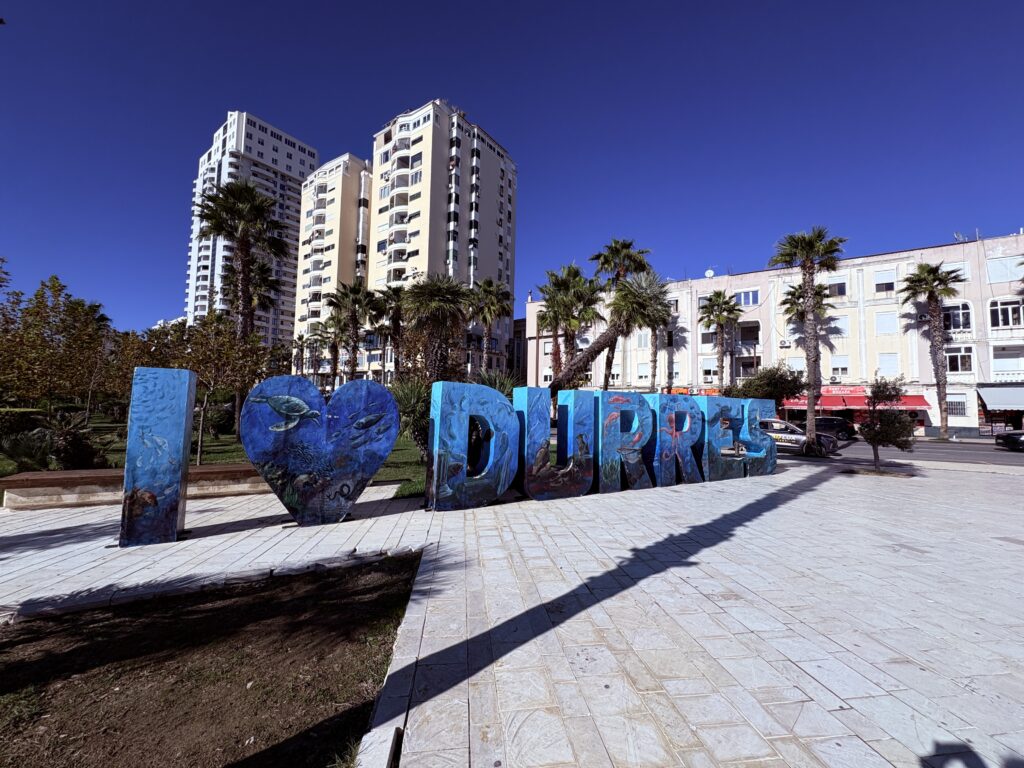
Krujë
My next destination was Krujë, one hour away from Durrës. The roads were really curvy to get to the Krujë castle. Once in the city, there were many parking lots next to touristic areas. I paid 500 ALL to park not too far from the castle. After that, I climbed up to Krujë castle. The castle is located in a nice park that is free to visit, and the museum entrace costs 500 ALL. The museum had three floors, and it depicts parts of Albanian history, in particular that of Skanderbeg. Skanderbeg is a hero of the medieval Albania and the museum depicted several scenes of his life. While there’s a couple of plates in English, most of the museum was in Albanian.


Day 3 – Ohrid, North Macedonia: Churches and Lake Views
After my friend arrived, we did some admin tasks to get to share the driving of the car, and then headed towards Ohrid. On the way, we had to stop to get a green card, a document helping you to get insurance coverage in North Macedonia. The car agency had explained how to do the whole process, so it was easy. This document is necessary to cross the North Macedonian border. We stopped in Përrenjas to buy it for 15€ and got some groceries for the trip. We then drove towards the border, which took a bit of time to cross, as quite a few cars in front of us also had to show our IDs and car docs.
Ohrid
We reached Ohrid at around lunch time. We dropped our car at our hotel, and had some foccacia sandwiches for lunch at Pane & Co Ohrid. The foccacia bread was delicious! We then went walking around the city of Ohrid. The lake views are absolutely stunning, and we were lucky that the day was sunny and pleasant. Once we reached the old city, there were several landmarks to be seen, including the Fortress, the Theater of Lychnidos, the Church of Saint Sophia, and the famous Church of St. John at Kaneo.
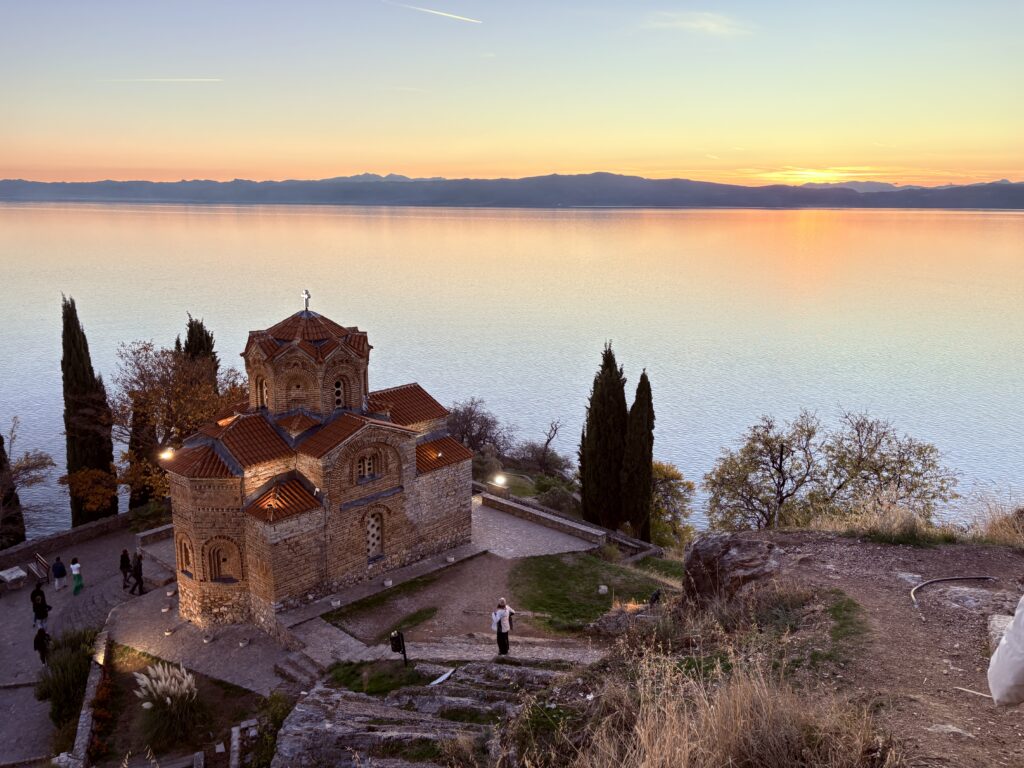
We headed towards the Church of St. John, which we could visit for 150 MKD per person, to see frescoes from the 13th century. Many saints’ pictures had their faces destroyed during the Ottoman era. The church itself is quite small, so after visiting it, we climbed to the hill to have a panoramic view of sunset. The climb is really easy, and it gets crowded for sunset. There’s a couple of benches to sit and wait for the sun to set. After enjoying the views, we descended through the lake side, which is a nice walk over a wooden boardwalk. What was left to do for the evening was to walk a bit around the city center, enjoying the old buildings and souvenir stores, and obviously have dinner at a local restaurant.
Day 4 – A drive through North Macedonia: Matka Canyon & Tetovo
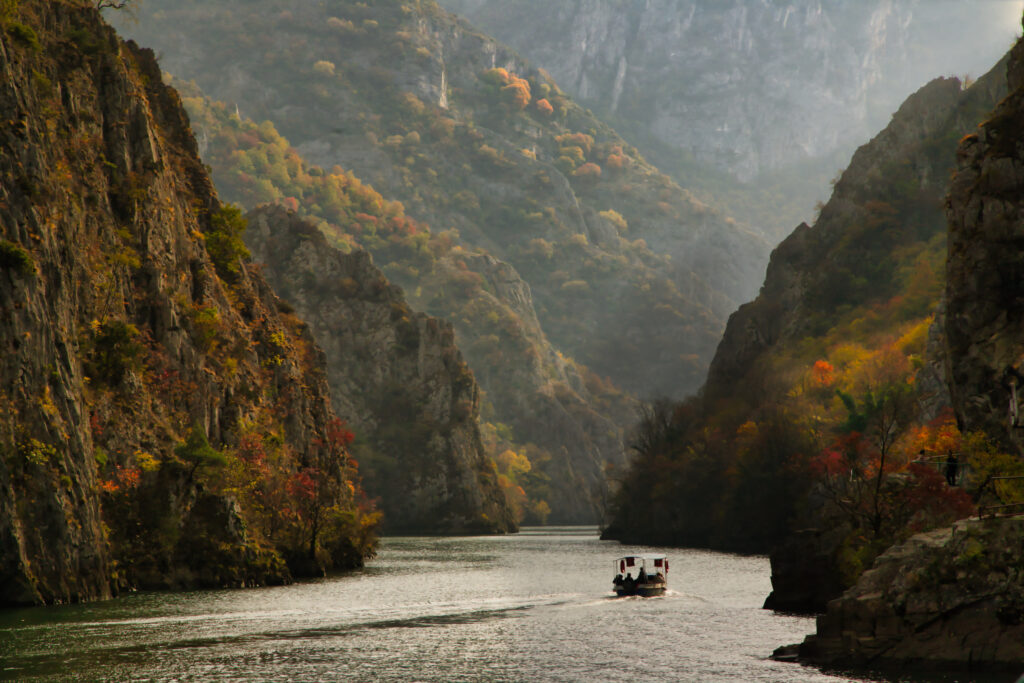
To take a better advantage of the sun hours, we headed towards Matka Canyon right after waking up. In November sunrise is quite early, around 6:00, while sunset is early too. The road was very scenic, with trees already in full fall colors.
Matka Canyon
Following the instructions of Google Maps, we reached the parking place (free) of the Matka Canyon (entrance free as well). The Matka Canyon is a very popular destination all year round, and it’s also close to Skopje, so it’s very accessible. Even in November it was quite crowded and there were some school classes that were coming to visit the place as well. We got to take a boat tour for 30 min through the canyon for 600 MKD per person, and then walked a bit through the hiking path. The path itself continues behind the restaurant, in what looks like a dead end. It’s an easy walk through the forest with good views of the canyon. The total path is quite long, so we just did part of it once we had enough of the views.
Church of Saint Athanasius
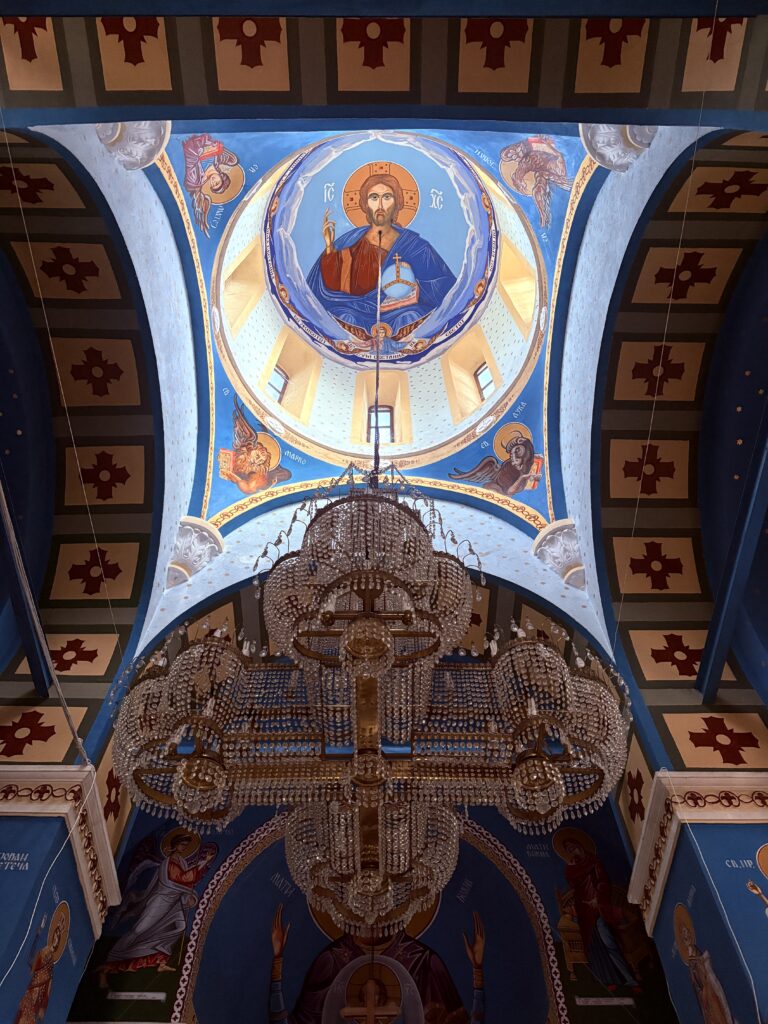
On our way to Tetovo, we stopped at the Church of Saint Athanaskus. The church is part of the complex of the Monastery of Leshok. The monastery had been demolished twice, once in 1690 and once again in 2001, being rebuilt in 2007. The entrance to the church is free, and it contains beautiful frescoes of saints with a blue background. It also contains the relics of Kiril of Leshok, a saint who lived in the 18-19th centuries and who wrote a few important works for the church.
Tetovo
Since we had decided to spent the night in Tetovo, we parked our car in the hotel and proceeded to explore the city. I’m not going to say that I found the city particularly interesting, it lacked some charm for me. When we asked the receptionist what to do, he only could come up with two attractions, which is what we did at the end.
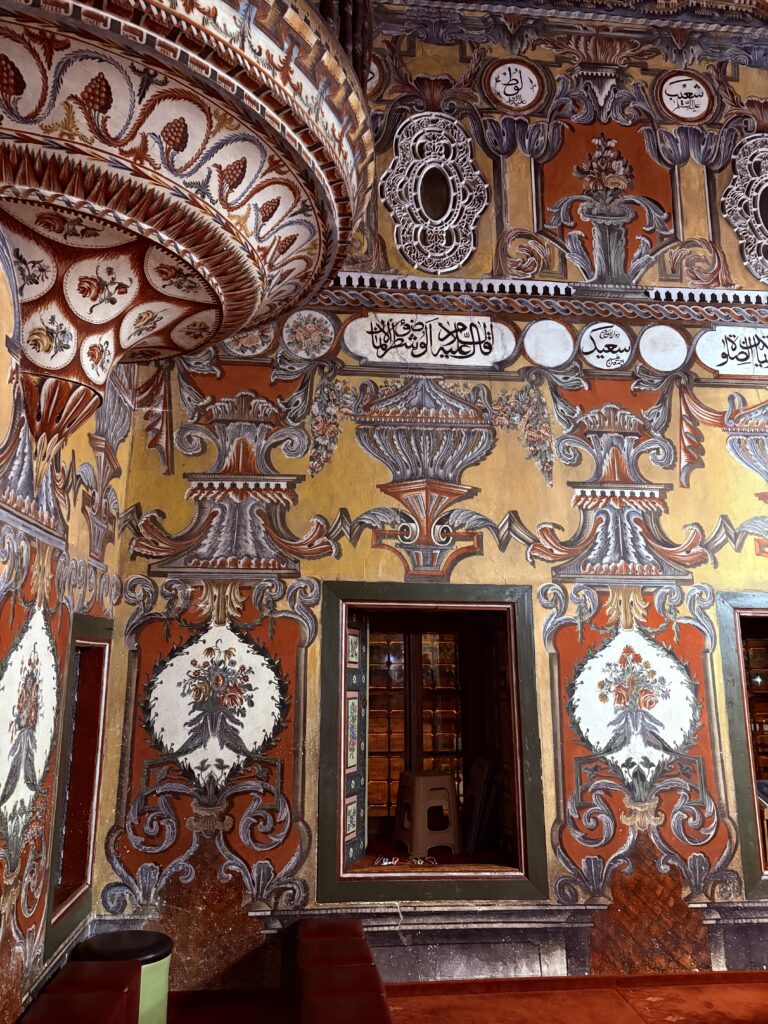
The first point of interest was the Painted Mosque Sarena Dzamija, a mosque that gets its original shape in 1838/39. The highlight of this mosque is the extensive decorations that cover it both inside and outside, drawing inspiration from the Italian Baroque. One can go inside the main room to visit outside of prayer times and no ticket is needed.
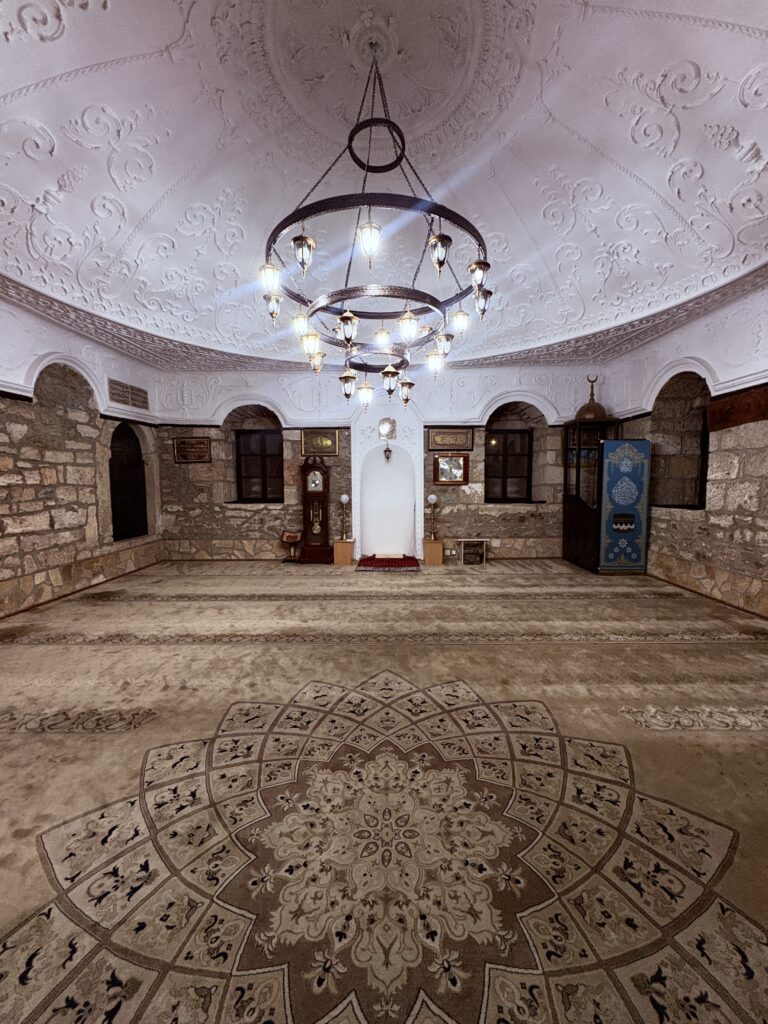
Our next stop was the Arabati Baba Tekke, a religious center founded in the 16th century. I’ve gotten some conflicting information about it, from it being a religious building but not a mosque, to it being a mosque. According to the Wikipedia article, there has been frictions between different factions about the use of the building. Anyhow, when we were there, a man invited us to come inside and we chatted a bit about the building.
Day 5 – Visiting Popova Šapka and drive to Skopje, capital of North Macedonia
Popova Šapka
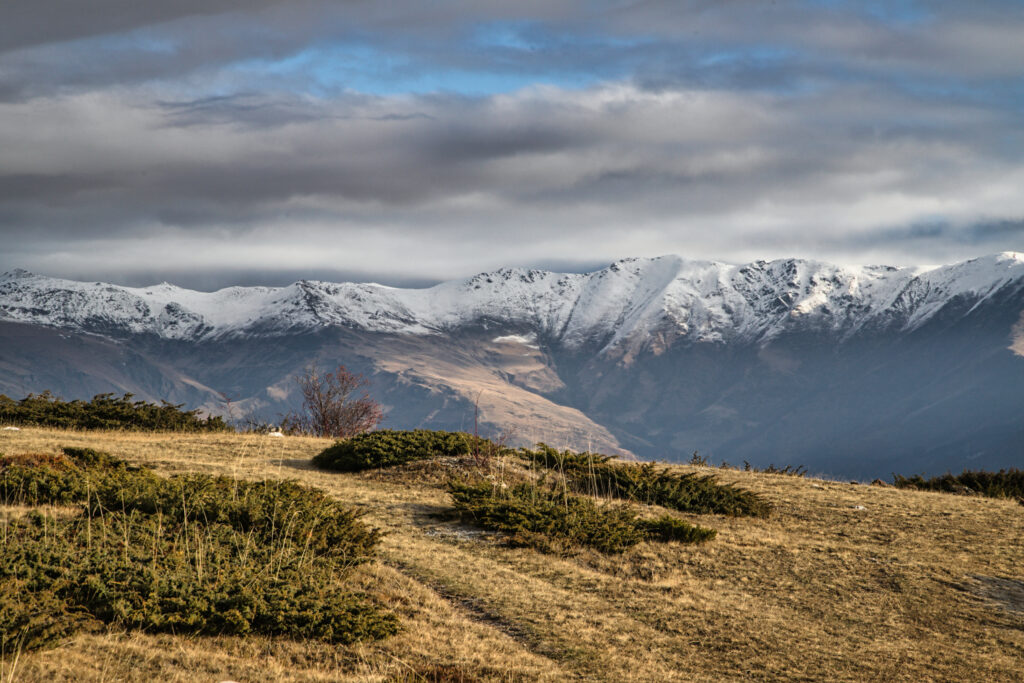
The guy from the restaurant we went to the previous day recommended us visiting Popova Šapka when we asked about attractions in Tetovo. We decided to drive 30 min there for a brief stop. That was an amazing recommendation! The sky was mostly clear, but there still was some clouds. The weather was chilly but not cold. The trees – beeches-, were already orange and yellow, which gave the forest a whimsical touch. We went all the way up the ski station, where one could see houses constructed with the typical mountain style. We stopped at a random place, from where we could observe the mountains surrounding us, already covered in snow. It was beautiful!
We would have liked doing the drive towards the peak, which was 20 min by car or 2 h by foot, but because that would void our insurance (no asphalted road), we didn’t do it. Nonetheless, that looked like a lovely path to take.
Skopje
From Tetovo it was a 50 min drive to reach Skopje. Our hotel in the city was in the city center – a ship lookalike. While parking was a bit hard (we had to leave the car in the shopping mall parking for 24€ the day), the hotel was really cool. Apart from being shaped and decorated like a ship, which was quite cool already, it was located in the middle of all what there is to see in Skopje.
Exploring the South Side of the River
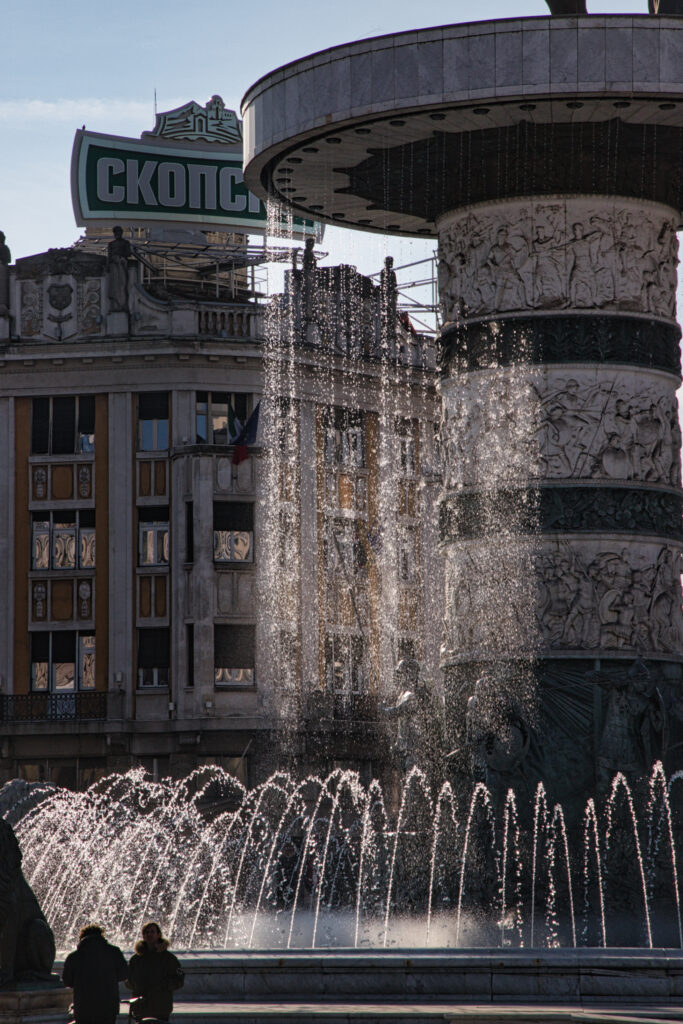
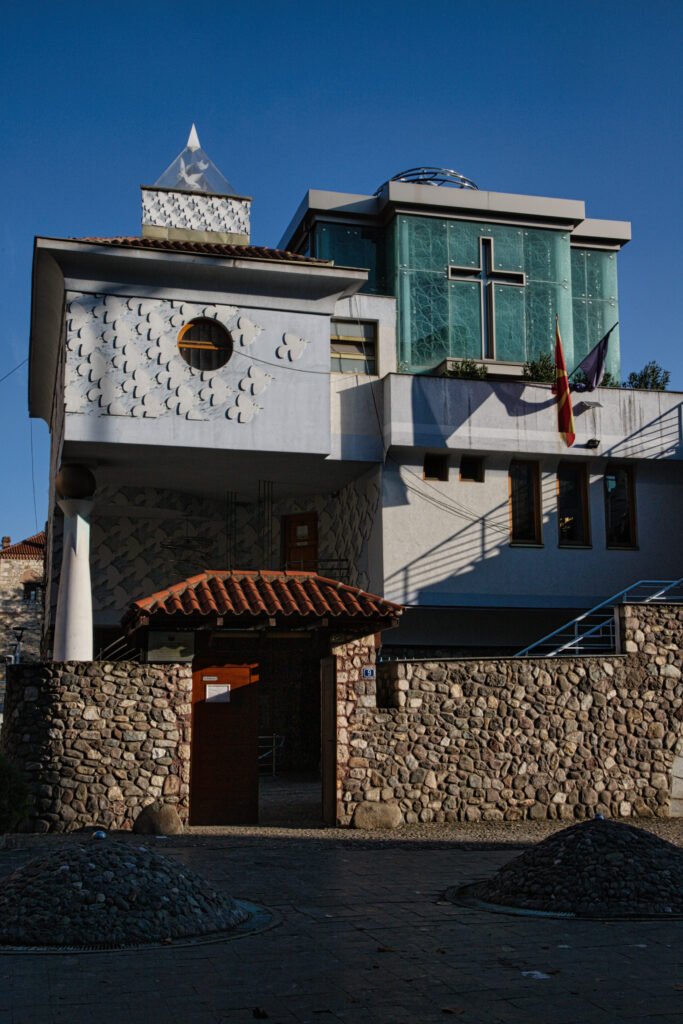
After quickly having some snacks, we joined a free tour to visit the city center. This way, we explored the Macedonia square, which contains several fountains and sculptures of people relevant to the history of Macedonia, like the tsar Samoil. We then continued to the statue of the shoecleaner, and from there, to the museum dedicated to Mother Teresa.
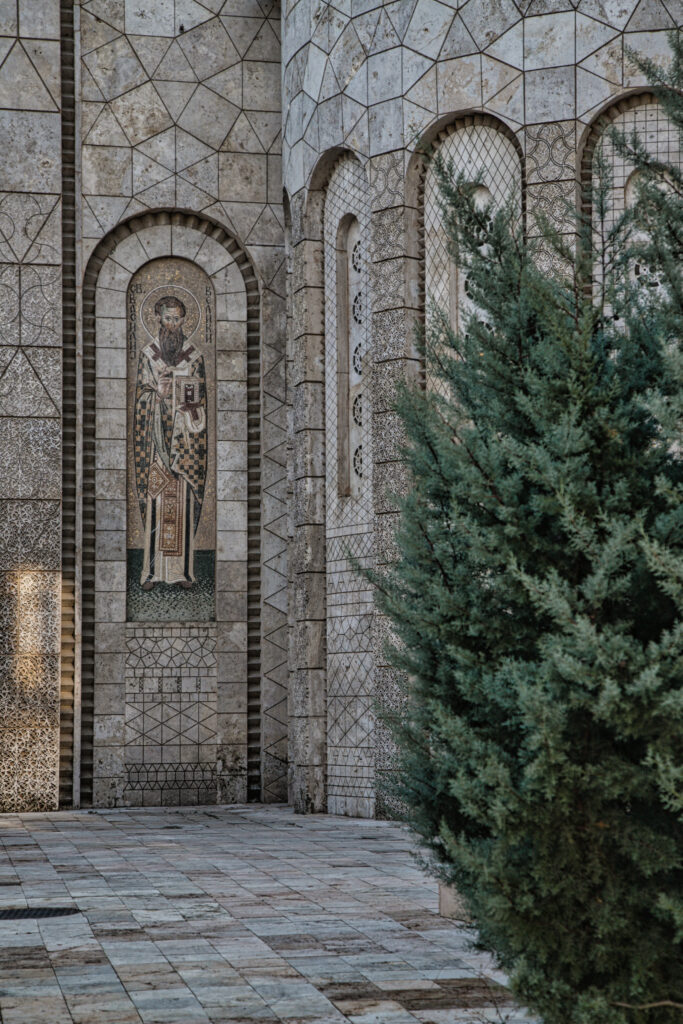
Mother Teresa is one of the key historical figures of North Macedonia, as her birthplace was Skopje. The little free museum has one floor dedicated to her history, with multiple photographs, and the second floor contains a modern-looking chapel dedicated to her. Right next to the memorial, there is an orthodox church, the Church of Saints Constantine and Elena. I found the church really beautiful, both from the outside, with intricate designs on the walls, as inside, where many figures of saints and religious figures were represented.
North Side of the River: Ottoman Heritage
We then crossed the Stone Bridge, having nice views of the Archeological museum, now illuminated with the warm sunset light. We could see the tender fountain dedicated to Olympia, the mother of Alexander III of Macedonia. In the sculpture, the woman appears in different stages of motherhood, including pregnancy, nursing, and just being with the child. In front of this sculpture, once can see the sculpture of Phillip II.
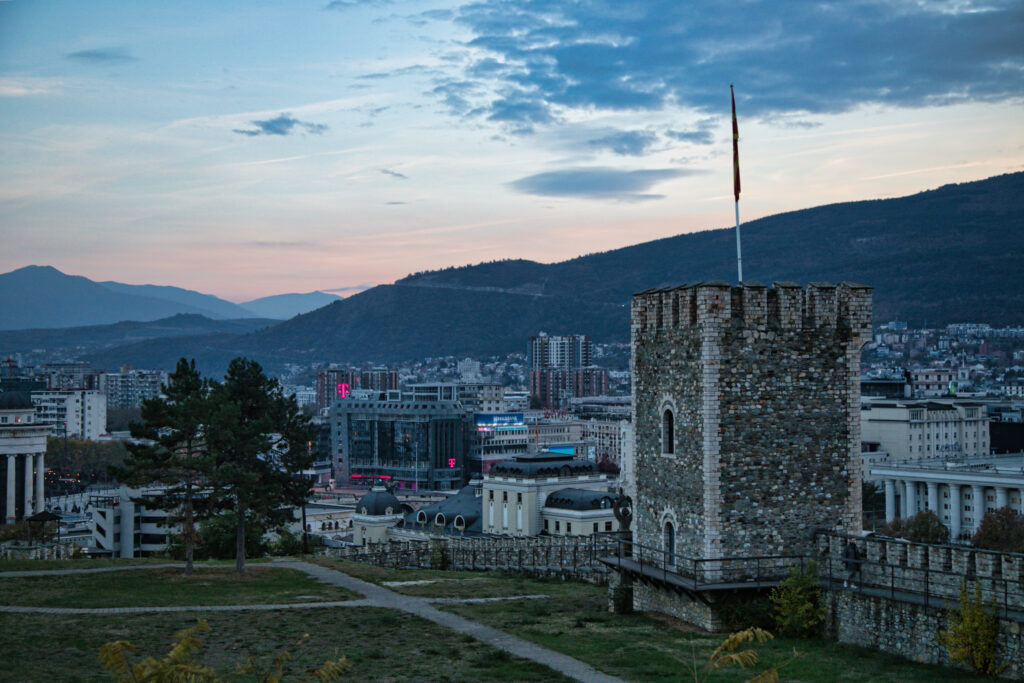
From there, it is only a short walk to the bazaar, which has plenty of places selling gold, cheap souvenirs, and also has plenty of local options for food. While getting the vibes of the bazaar was cool, we were not particularly interested in buying anything, so we headed towards the Skopje Fortress to have time to visit it before dark. While google says it’s open until 18, it was actually closing at 17, when it was already dark. The fortress is a cool, quite well-preserved construction, that gives some opportunities for climbing and photography.
For dinner, we decided to use the facilities of our ship-hotel, where the food was really tasty!
Day 6 – Excursion to Peja, Kosovo
Finish visiting Skopje
Before leaving for our next destination, and to take it easy in the morning, we had another stroll through the city. This time we reached the orthodox Cathedral of St Clement of Ohrid. The outside is not necessarily to my liking, but the inside of the church was really beautifully decorated, with colorful frescoes of religious figures. As the sky was getting too grey, we decided to continue with our trip.
Peja
The border with Kosovo was very quick to cross. We were really impressed by the highway to Pristina, which was a relatively new construction (2019), and still very well-maintained. In comparison with the roads in both Albania and Macedonia, the roads in Kosovo felt better.
The region next to the border has quite some mountains, covered in beautifully orange trees. The roads in Kosovo are quite centralised, so to go to Peja we had to pass by Pristina. When we arrived to Peja, we passed by the tourist office, although it was unattended when I went in. It looked like the main tourism offered in the region is nature/adventure, with an extensive offer of hiking routes and via ferratas. Nonetheless, we still wanted to visit a bit of the city itself.
The Peja Monastery & the Hammam
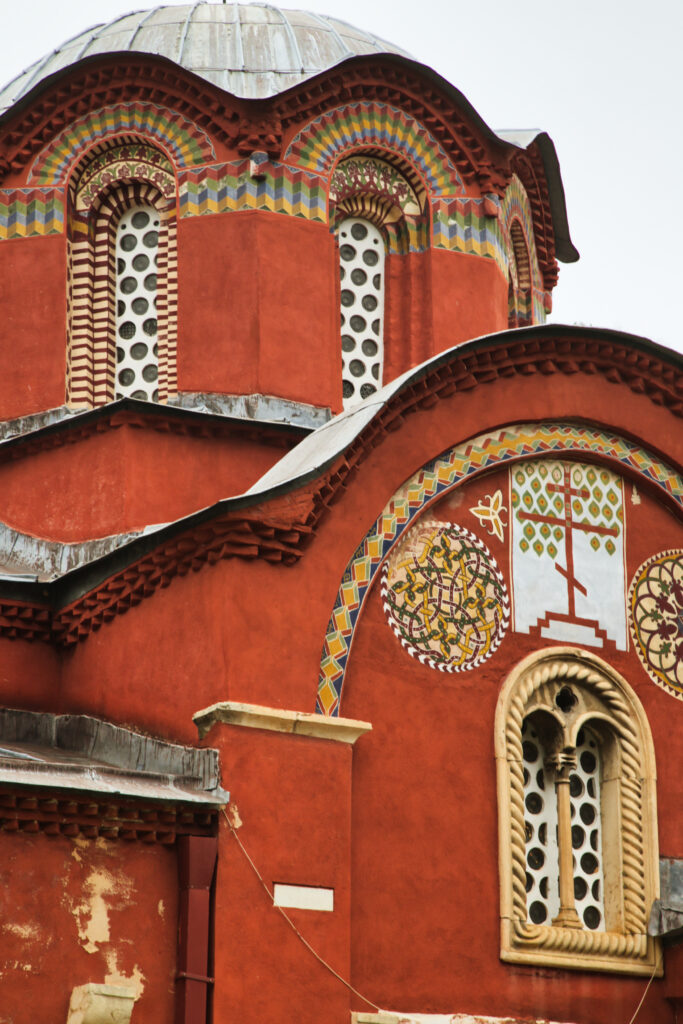
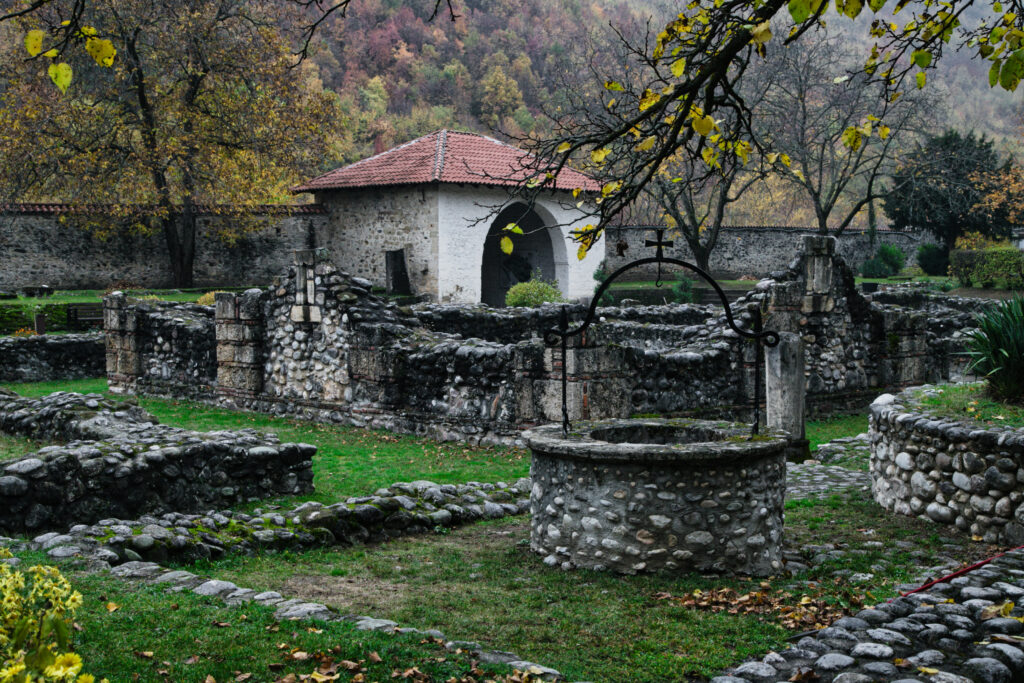
Our first stop was the Peja Monastery. I was surprised by how controlled the access was. There was a barrier to enter, and a policeman requested our passports to enter. It is possible to park the car inside of the facility after showing the IDs, although we didn’t know it and parked outside. We then walked towards the monastery, which was a short 5 min walk through an asphalted road.
The monastery is still active, with nuns living in the facilities. Obviously, the parts where the nuns live are closed to the public, but one can visit the archeological site and the church of this UNESCO World Heritage building. The photos of the place that I had seen before coming didn’t do it justice. The nuns have created beautiful gardens around the church, which give it a lively atmosphere. We could also visit the church inside. There’s nice frescoes, more ancient than the ones we saw in previous churches. Some of the saint’s faces have been destroyed by the ottomans. Photos were not allowed inside, but it’s worth taking a look.
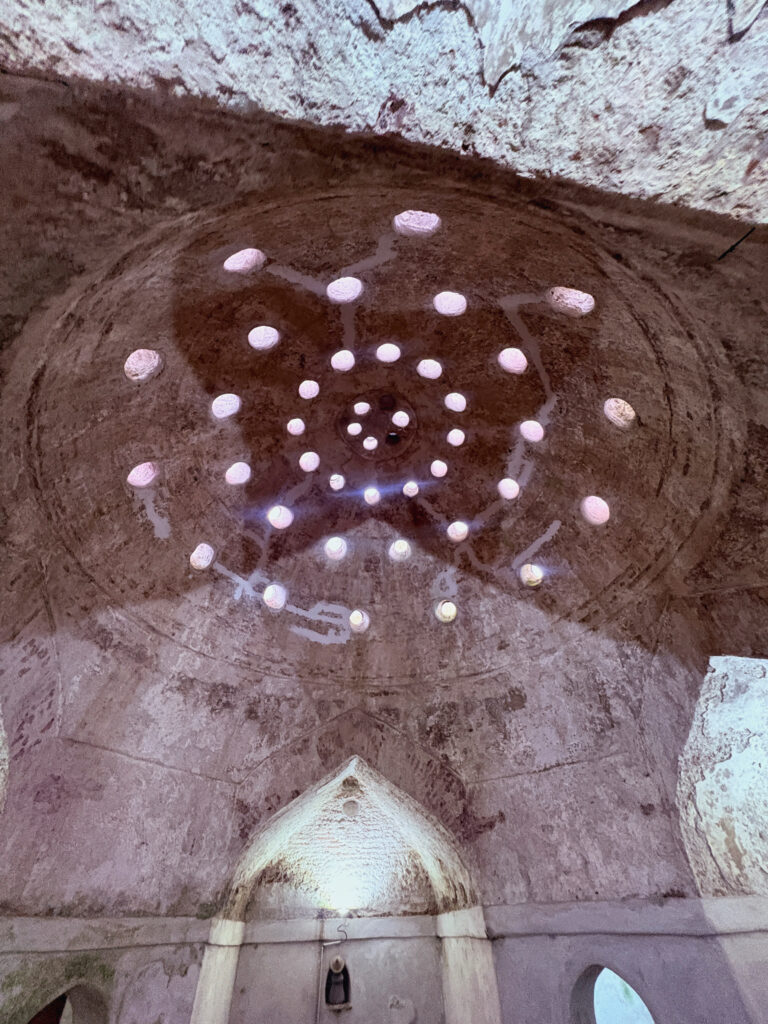
After the church, we drove to the city center and parked at a 0,5€/h parking lot. We walked a little, seeing the typical houses (kulla) from the region made out of stone with two floors. We then arrived to the old hammam. This was a really interesting visit, as our guide was also the man who had done most of the restauration of the hammam. He was very passionate about the building, and you could see that he was sad about not getting enough protection and financial support for it, as the building was being repaired basically with his money and the little donations from tourists.
Quick visit to Rokova Gorge
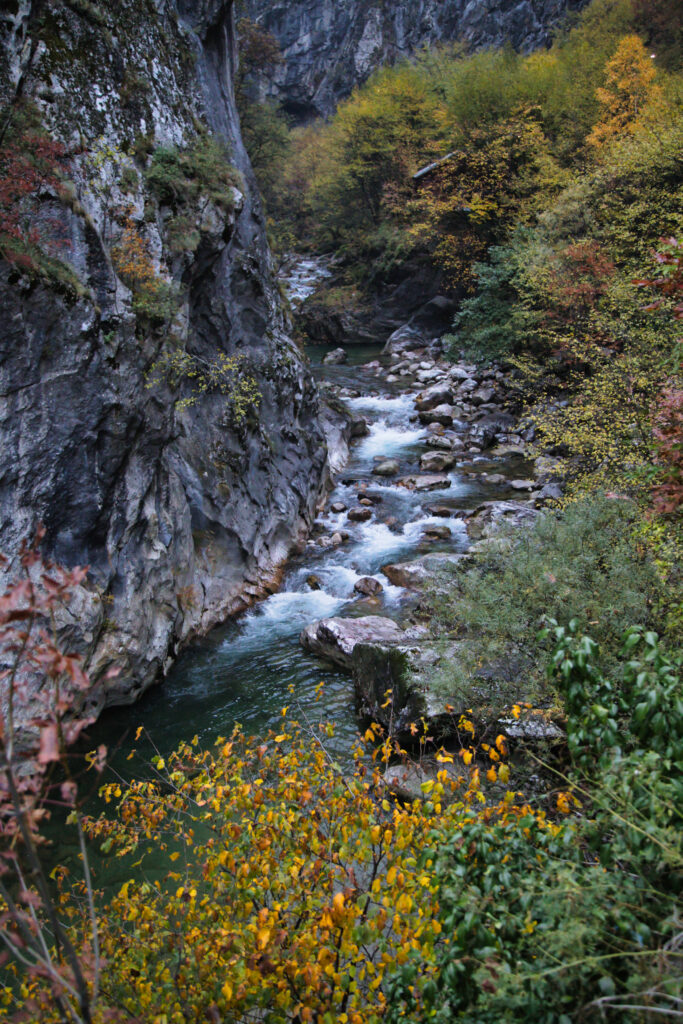
It was soon getting dark, but we couldn’t leave Peja without at least having a look to the Rokova Gorge. We drove to the closest viewing point we found in Google Maps, which had some tables but no good viewing platform. We ended up taking a couple of photos from the car bridge. Then, we drove a bit longer, to the next viewing platform. This one was more adapted to tourism, with a (broken) glass platform, and some stairs that were technicaly leading down to the river, but that were broken too, so we could not reach the river.
Gjakova
It was already dark when we arrived to Peja again. From there, we decided to drive to Gjakova, a city in the south, to check it out. Unfortunately, the bazaar was already closed, although the area around the city center seemed quite cool. From Gjakova, we drove to Pristina, where we had our last hotel.
Day 7 – Visit Pristina, capital of Kosovo, & head back home
Pristina
After some hesitation about which museum to visit, we started the day going to the House of Independence of Kosovo “Dr. Ibrahim Rugova”. It’s a good museum to learn about the history of Kosovo, but it requires lots of time to go through, as it consists of many panels explaning different aspects of the history, with much focus on contemporary history. As many museums in Pristina, it was free and one could give donations.
Close to the museum there is the Newborn monument, which commemorates Kosovo’s independence. It changes decoration every year based on recent events. Right in front there is the memorial Heroines, for the women who were raped during the war. The crimes commited against women during the wars are often buried by history, so I found it a great initiative to dedicate those women a monument. The memorial itself is very interesting, with the face of the woman made out of medals, each of which has the same face on them.

Walking through the main monuments
We started our guided tour next to the Mother Theresa Cathedral. This is quite a recent church, inaugurated in 2010. The church is quite simple inside. I was surprised by the presence of windows decorated with images of the last Popes. I’m used to see old churches, so contemporary faces feel out of place, although it does make sense that new buildings will incorporate new people.
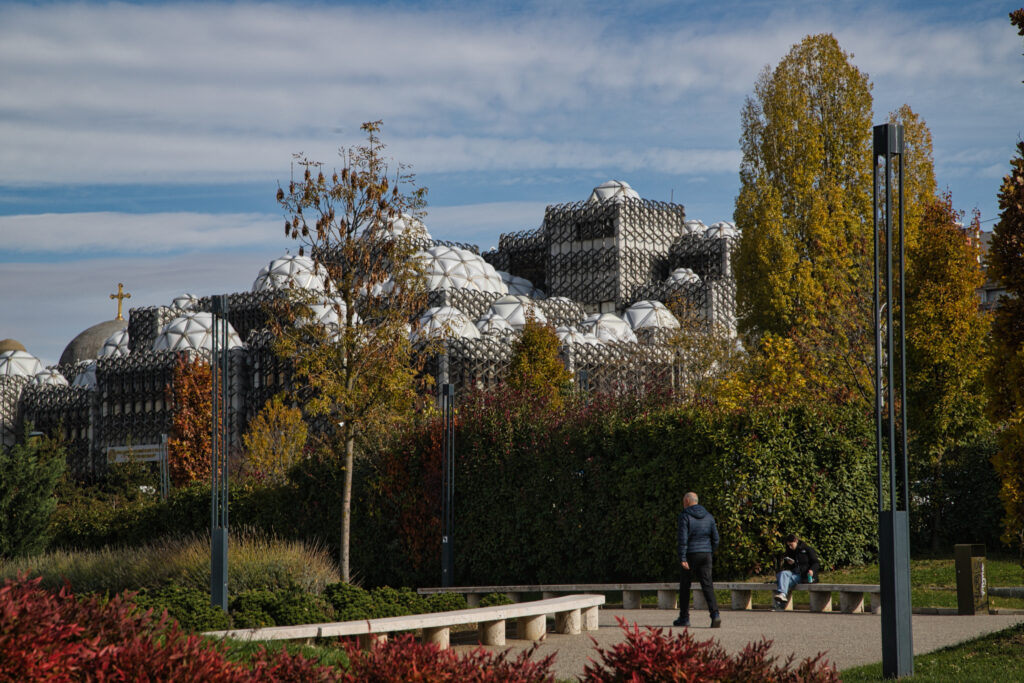
We then headed to the National Library of Kosovo “Pjetër Bogdani”. This is quite an interesting building, built in 1982. The shape, according to its Croatian architect Andrija Mutnjaković, was meant to be a combination of Bizantine and Islamic styles. It has 99 domes, which give the rooms inside plenty of natural light. Certainly not everyone likes it and the building itself has been part of several controversies.
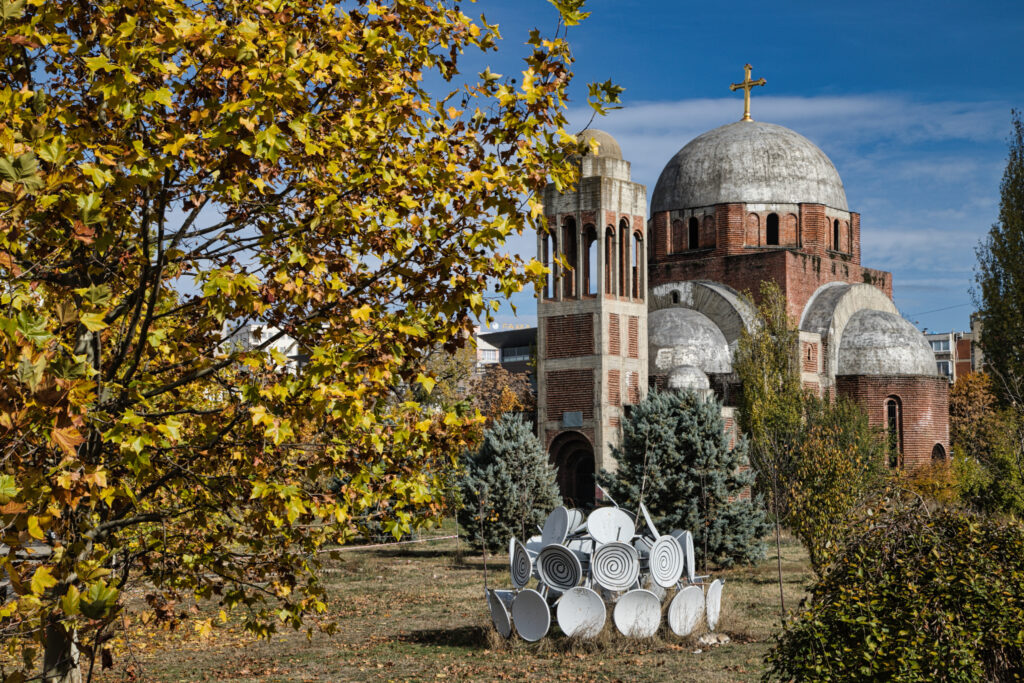
We then passed by the Newborn and memorial Heroines again, before heading to the statue of Madeine Albright, a former United States Secretary of State, who is appreciated for the help the US provided to Kosovo. Next to it is a mural with Dua Lipa. Did you know that her parents where born in Kosovo and she holds now also the passport?
Visiting some of Pristina’s museums
The Reporting House if an exhibit showing the history of Kosovo from the lens of the press, and it also displays some contemporary art. It was opened for the 25th anniversary of the end of war. The museum is free to enter, and while not very big, it has several videos with reports of witnesses of the war, so you can spend there quite a few hours.
After we finished seeing the museum, we walked to the bazaar, where we finished the tour. Since it was close by, we headed to the Ethnographic Museum. It’s quite a small museum, with only one building open to the public when we visited. The house had a few rooms, with some artifacts of traditional Kosovar style. There was a man in the biggest room, who gave us a brief explanation of some artifacts. The museum was also free.
Practical information
How safe is it for women to visit?
This answer depends on the country that you’re visiting.
Safety in Albania
I did Albania solo, before my friend arrived and joined me. While I did not have any negative experiences, I was -too often for my comfort- the only woman in the place. I don’t know why, but there’s not many women in Albania walking around. The ones that I saw were often accompanied by their partners or part of a group. Else, most of the time it was men or groups of men who were on the streets.
I had a few older men approaching me to chat for a bit, which didn’t feel threatening but more a matter of curiosity, but I can imagine such attentions are not always welcome. Only once I felt a bit threatened, when a guy started walking towards a viewing platform in which I was alone, too early in the morning for more people to be around. He most likely also wanted to check out the views, but I felt uneasy enough to leave before I wanted to.
Safety in North Macedonia
In North Macedonia the situation was similar to Albania – very few women in the streets, especially in Tetovo, which seemed more conservative. Certinly, there were some places that even during the day seemed a bit iffy, as Tetovo is not a touristic place (even the receptionist of the hotel had to think for a while to recommend something to visit).
Safety in Kosovo
On the contrary, Kosovo was positively surprising for us. The proportion of women by themselves on the streets was much higher in most of the places we visited, and that makes a big difference on how safe a place feels. The roads, especially in Pristina, were much wider and organised than what we’ve previously seen, which contributed to the feeling of safety.
As always, anything can happen anywhere, so be mindful of your things and don’t get into places you wouldn’t in normal circumstances, but overall, all the Balkans can be easily visited by women by themselves.
Internet connection
We had WiFi in all hotels, but there wasn’t signal in many more places. Because of that, I recommend using an eSIM. In this case, I purchased a plan with maya.net. I usually use maya for most of my trips and it’s reliable in the service it provides. The main advantge for this trip, additionally, was that maya also provides internet in Kosovo, which most providers don’t. To avoid bothering with two different SIM cards, maya offered an excellent alternative for 20 € the week.
What money do they use?
In the three countries, euros are quite commonly accepted. However, in Albania and North Macedonia, it is recommended to exchange to the local currency to avoid unfavourable change. Albania uses the Albanian lek, while North Macedonia has the Macedonian denar. Kosovo uses the euro in a non-official way. Change can be done in exchange houses or by getting money from the bank, but I got the impression that getting change in the exchange houses was a bit more favourable.
In these three countries, cash is king. Cards are rarely accepted, and it can be that your taxi driver doesn’t have a card reader. Try to get enough cash to get by.
What’s up with all the dogs and cats?
When in either of the three countries, one can see many homeless cats and dogs. Our guide explained that there’s no campaign to sterilize the animals and try to get them off the streets, and if some of the animals had a chip, it was most likely paid by a particular person. The dogs would often follow you, trying to get some food, and we had a couple of cats who also showed hungry interest in us. None of them was dangerous, and after seeing that you don’t give them food, they quickly moved away. It’s sad to see the state of some of the animals, who definetly looked like they lived a rough life.
Are museums in Kosovo free?
I can’t say if it’s the case for all museums, but all of the ones we got to visit were free. That being said, there was a bit of an expectation of a donation. Obviously it’s not compulsory, but often the person working in the museum takes the time to guide you, and you’re also often the only visitor. How much to donate depends a bit on how much you liked it and how much effort your guide put. In some cases we left only a few euros, while for the hamman we left about 20€, as our guide spent about an hour explaining us about the hammam and the history of Kosovo
Is one week enough for three countries?
Not gonna lie, it was a bit tight. I’d say that if you do this route in summer, you’d get a much more comprehensive experience. November is a great month to visit to avoid crowds and get good deals, as it’s a shoulder month, but it usually has poor weather (although we were lucky!) and short days. Thus, for a November trip I’d say having maybe half a week more would have been better.
Looking for more inspiration?